
Selecting the correct winch requires understanding how load, speed, duty cycle, and mounting impact performance and safety. Review the considerations below before specifying a winch.
Maximum line pull depends on the cable layer being used and must not be exceeded. Refer to the capacity charts for each series. For example, pulling 8,000 lb with 75 ft of cable on the drum requires a Series 12 winch, as a Series 8 winch is only capable of 6,020 lb with that amount of cable.
Do not exceed the published line speeds for mechanical winches without consulting the factory.
Ensure the selected power source meets the winch requirements listed in the specification tables.
Applications involving suspended loads require a worm brake. Other applications, such as freeing a vehicle stuck in mud, may not. Winches with worm brakes must have the cable wound according to the brake configuration.
Braked winches can be configured as either overwind (cable spooled over the drum toward the brake housing) or underwind (cable spooled under the drum toward the brake housing).
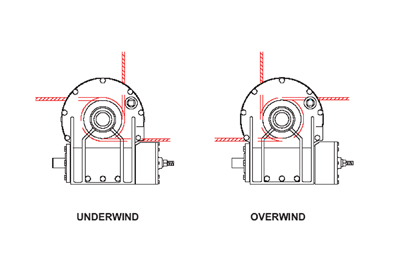
A drum clutch is required if the cable must be pulled off the drum by hand. If freespooling is not needed, a keyed drum offers greater reliability.
Winches are rated for intermittent duty only. Excessive operation can cause elevated oil temperatures, leading to oil breakdown, reduced efficiency, and accelerated wear.
Winches should be mounted with the worm shaft horizontal and below the drum. Alternate mounting orientations may result in inadequate lubrication. Worm brakes must be mounted below the oil level to function correctly.
Custom options include additional cable capacity, higher line speeds, grooved or divided drums, galvanizing, stainless steel shafts for corrosion resistance, special mounting configurations, and alternate power sources. Contact RKI to discuss application-specific requirements.